I spent a lot of time in the school library when I was in high school. I had an unreliable dial-up Internet connection at home, (boop boop boop)-boop boop boop-boop boop boop boop kshkshkshksh ptang ptang ptang kshkshkshksh, my parents wanted to avoid paying for Internet access, so we used NetZero, surfing the web with an adbar at the top of the screen for a maximum of forty hours a month. So, every morning during homeroom, I would get a hall pass and go to the library and use the computers there and check my email and play Tank Commander on Pogo.com.
My classmates enjoyed my theory about the library computers. (You must know that the computer desks in the library were quirky. They were glass and the monitor would sit underneath, so, rather than the monitor being at eye level, one had to look down through the desk at the screen.) I suggested that the glass desks with the monitors underneath, sitting in neat rows in the library, were actually an array of lasers designed to annihilate Soviet satellites. For this laser bank to be useful, of course, the library needed a hinged roof that could open to expose the laser monitors as the enemy satellites would pass overhead; this secretly hinged roof would prevent our enemies from finding our secret laser battery.
People would ask me questions about the hinges and the lasers and whether the Soviets were still active at the end of the nineties, when I was in high school, and I would contrive answers to keep the story afloat. It was a great conspiracy theory in that we all felt that it explained some things about the deviousness of our school establishment, it captured our sentiment and expressed our shared symbols and values, with the advantage that none of us actually believed the story about the hinges, and, thus, suffered none of the ill effects that accompany delusion.
I would go to the library at other times, too. The library was where you would go if your parents didn't sign the permission slip saying that you could be exposed to controversial course material. For example, my parents pulled me from health class for the unit on human reproduction and sexuality, and so I sat in the library, alone or perhaps with one classmate, and did bookwork instead.
My English teacher transcended her humanity and represented all of secular culture to me, a conservative Christian kid who had been homeschooled. People like her are the reason that devout Christian parents send their kids to Christian colleges and teach them about having a Christian worldview. One time, my teacher wanted to show The Breakfast Club, an R-rated movie, in class, during our unit on "Young Adult Literature", and Mike the Jehovah's Witness and Dave the Baptist and I sat in the library and had to read a short story about an Asian teenage boy dealing with issues of race and generational difference with his parents, and then we each had to write our own continuation of this story. We were in the honors class; the students in the next-most-prestigious English class got to watch Star Wars.
My English teacher also had us read Of Mice and Men, which supports euthanasia. Another time, she taught us about ethics. We had to consider, for example, a situation in which there are ten people in a cave, and they're trying to get out, and the fattest goes first and obstructs the opening to the cave and cannot be extracted from said opening. Would the people in the cave be justified in blowing him up with a stick of dynamite if it were necessary for their escape, supposing they would die of hunger in the cave, otherwise? We had to write essays giving our opinions on such contrived scenarios. I had been taught, in my Christian worldview education, to be wary of such lessons, because they are designed to erode belief in an absolute moral truth.
Basically everyone agrees that my high school's library doesn't have hinges on the roof for the anti-Soviet satellite lasers. Basically everyone agrees that water flows downhill and the earth is round and Amway is a scam. I dismiss flat-earthers out of hand; I don't even trouble with rhetoric. So many people believe so many wacky little things that it's not worth the time, generally, to investigate something that only a few people believe. Most people aren't existentially troubled by Jehovah's Witnesses because they know that the Jehovah's Witnesses are a cult and there are oodles of cults, and they can't all be right and it's not worth the effort to do a lot of research on every cult that exists to see if it might be right, so it's probably not worthwhile to investigate the beliefs of just one cult to see if that one happens to be the lucky one. I'm not saying that the majority's always right, but it's often passably close enough to being correct.
Growing up, I had many opinions that conflicted with the majority viewpoints in American culture, I was pro-life and creationist and anti-feminist. I didn't have many opinions that diverged from those of Dr James Dobson of Focus on the Family. I felt like I was part of a persecuted minority as an evangelical. The persecution was minimal, but evangelicals who take stances as extreme as mine are, indeed, a minority among Americans.
People are biased and easily swayed and duped; when we form opinions, our attitudes and desires play as much of a role as observation and reason, but I like to think that I'm better than average at observing and reasoning and being impartial. I bet you feel the same way about yourself. I bet most people do.
I'm a vegetarian, and not just to be stylish. I object to the way in which animal agriculture is conducted in America. Most people aren't vegetarians, and I think I need a good reason to justify to myself why my minority viewpoint isn't a wacky one like belief that colonic irrigation is helpful. I've looked into how animals are treated on farms, and it's bad in a handful of ways, and I think that if most people knew how we treat animals, they wouldn't eat meat, either, unless the conditions would improve. I think that most people are uninformed about the horrors of modern mass animal agriculture. The only pop culture reference to factory farms, that I can think of, is the scene in Napoleon Dynamite in which Napoleon works at moving chickens from one cage to another.
When I believe something unusual, but I know that it's because I happen to have some extra information, I can understand why people would disagree with me. As a creationist, I had trouble believing that evolution is a false but popular belief simply driven by factual errors. I knew that most biologists are evolutionists, and that they are more educated than I was. I needed a way to distrust them to be justified in disagreeing with them. I needed to believe that evolutionists believed in evolution because they were rebellious and wanted to avoid God. I needed quotes like this one by George Wald:
"There are only two possibilities as to how life arose. One is spontaneous generation arising to evolution; the other is a supernatural creative act of God. There is no third possibility. Spontaneous generation, that life arose from non-living matter was scientifically disproved 120 years ago by Louis Pasteur and others. That leaves us with the only possible conclusion that life arose as a supernatural creative act of God. I will not accept that philosophically because I do not want to believe in God. Therefore, I choose to believe in that which I know is scientifically impossible; spontaneous generation arising to evolution."
(Wald, George, "Innovation and Biology," Scientific American, Vol. 199, Sept. 1958, p. 100) [It turns out that this quote is fake. I had seen it as a creationist and it was important to my thinking, though.]
I grew up in an environment that distrusted the majority. I remember one gathering of homeschooling families, at which some kids taught others to make fortune tellers; my parents don't mind fortune tellers, but some of the other parents were afraid their children would become occultists, and there was a brouhaha. On the other hand, I wasn't allowed to watch Captain Planet or Teenage Mutant Ninja Turtles because they espoused eastern mysticism. Before I saw Pochahontas, I was given a disclaimer that trees and rocks do not, in fact, have spirits in them.
I dismissed the pro-choice movement as a bunch of eugenicists who wanted "sexual freedom" outside the confines of marriage. I saw feminists as women who just wanted to push men down out of greed and thirst for power. I believed that Catholics and Muslims were basically hell-bound, they chose wrong beliefs because they were trying to earn their salvation by works, they wanted a sense of ownership of their destiny. Hindus were right out.
I am the oldest of six kids; the next oldest is Spencer. He told me tonight that he used to think that people with acne had it because they had AIDS; we were under the strong impression that people with AIDS got it from having sex outside of holy matrimony. I'm glad that Spencer was corrected about the cause of acne before I had my first outbreak.
Growing up, we were taught that our media is driven by things that are cheap and corrupting, and we were banned from watching The Simpsons and The Golden Girls as a result. I didn't even want to watch The Golden Girls, but we had a rule against it just in case. We were encouraged to listen to Christian rock instead of secular rock.
One time, Spencer was at a friend's house, the friend happened to be the son of our pastor. He played "All the Small Things" by Blink-182 for Spencer, he'd downloaded it off of Napster. Listening to it, Spencer thought, "There's not a single bad thing in this." He realized that he'd been taught to distrust secular music, as a uniformly corrupting influence, and he thought that maybe it's not as bad as he had been told. He downloaded a lot of songs on Kazaa, (boop boop boop)-boop boop boop-boop boop boop boop kshkshkshksh ptang ptang ptang kshkshkshksh; that's how I got introduced to the Barenaked Ladies. Spencer had been previously satisfied with Christian music, but, comparing it with the mainstream music, he realized it wasn't nearly as good. He noticed and reconsidered other ways in which he had been taught to disagree with mainstream culture, and it wasn't long after that that he stopped believing in God altogether.
The summer after I had my big existential crisis in which I got a haircut and a cellphone and became a vegetarian, I realized that I had drifted, over the previous two years, from being an avid young earth creationist to not caring very much one way or another about evolution. I went to the library and got a big stack of books about evolution, written from various perspectives. I was in the mood for change.
People trust the beliefs of their own tribe over those of another tribe, even if they don't have any good reason to think that their tribe is more honest or better at logic. When Spencer started listening to secular music, he was learning this. My problems with anxiety, and my realization that I had faulty motives for having long hair and not having a cell phone and so on, led me to trusting myself less, in a good way. I was humbler. I am prone to thinking that my opinion is correct simply because it's mine, I suppose a lot of people are like this, but at that point in my life, this tendency was weaker. I had trusted myself a lot when it came to having opinions about politics and doctrine and evolution, and I found that trust in myself to be limiting because it could only be as big as me. I wanted to find something else that I could trust, with more insight than myself about these things.
I read the big stack of books about evolution. I realized that the scientific community strongly affirms that the universe is very old and that there's a fossil record that's consistent with evolution and that biology has some good answers about where the first cell came from and how mutations occur and percolate through populations. What was more important to me, I think, was that I stopped seeing the scientific community as having insidious immoral ambitions; I saw no signs of a mass conspiracy to hush creationists so that abortions and gay marriages can be so common as to be passe. I started believing in evolution, and not even liking that word "believing" in "believing in evolution" because evolution is scientific and I don't talk about believing in gravity or neutrons. I had changed my opinion about evolution because I figured that the scientific community is more trustworthy than my own intuition when it comes to things that I'm not an expert on. I was looking for experts on other things too, like how babies should be baptized and how miracles work and how to become holy and why a lot of my fellow Christians act like wingnuts and how I could know that I'm not a wingnut.
Showing posts with label evolution. Show all posts
Showing posts with label evolution. Show all posts
Tuesday, December 15, 2009


Tuesday, October 20, 2009
Triangles: People, nature, and God
I'm a big fan of dumb arguments. I think there's something cute about this argument that recycling is overrated: if recycling were substantially more efficient than extracting raw materials from holes in the ground, you'd be paid to recycle. I would get lost doing cost-benefit analysis on energy savings and reduction of pollution. The problem is complicated enough that whoever's doing the study can fudge the numbers to favor their personal biases. Recycling might be good, but no one's made it worth my effort, so I can tell that I'm at least not doing a lot of harm by burning all my styrofoam cups and plastic bottles in the backyard.
Arguments for God's existence, based only on knowledge of nature, any of them from the young earth creationists' casting aspersions on radiometric dating, to the denial that abiogenesis could have occurred without divine intervention, to the argument that the universe itself is so fine-tuned it must have been made by an intelligent designer, all of these arguments are hideously complex. I like to think that I'm almost a smart person, and I haven't been able to work out the math on any of these for myself.
I've been on one side or the other of these sorts of arguments, and I now find them dull, to the point of pain. I'm ready to say, "The earth is 6,000 years old, it was made on October 22, 4004 BC, life can't come from non-life, we live in an incredibly complex universe that couldn't have been an accident, and bananas were designed with human consumption in mind." I would say this just to escape from this sort of discussion the next time I'm trapped in one. I'd like to see what happens next. I suppose this would make the argument a lot dumber; I'd prefer to talk about whether a personal God can be known through impersonal nature over talking about abiogenesis and astrophysics and accumulated aquatic aluminum.
I suppose one could call this uncaused cause God, it's all semantics, that's fine. But, how does one make the jump from this uncaused cause to belief in Hashem or Allah or the Fates or the Triune God of Reformed Theology? When people ask each other, "Do you believe in God?" I don't think they mean, "Do you affirm that the universe results from an impersonal uncaused cause?" (Also, they rarely mean, "Do you believe in a divine essence who hates you?") Whenever I ask the question, I'm not directly looking for information or opinions on God, I'm trying to understand my interlocutor: the implied question is, "Do you try to relate to a god? How?" Nothing about causality or complexity or even beauty in the universe suggests that there's a big something that would care to interact with us.
So why do religious people try to demonstrate that their God can be known from observation of nature? Religious people who came to belief through mere study of the cosmos are rare. Most religious people were raised in their current religion. Most converts become converts not through a systematic exploration of alternatives, but through the influence of their friends.
I suppose that, for Christians in particular, the historicity of the resurrection is enough of a reason for belief for them. Likewise, Jews and Muslims would appeal to other supernatural historical events, the deliverance from Egypt and the giving of the Koran, respectively. (Non-monotheists tend to be less concerned with academic proofs that any God exists.) What stake do the religious have in the idea that God can be known from nature, if, in general, that's not how they themselves came to belief in God?
I first became interested in arguments about God and nature because I wanted to interpret the Bible literally; I didn't care much about proving God to other people, I was trying to reassure myself, that my beliefs about God were compatible with reality. I suppose that's one reason why I've had stake in the relationship between God and nature.
Another reason to talk about knowing God through nature is found in Romans 1:18-21:
18For the wrath of God is revealed from heaven against all ungodliness and wickedness of those who by their wickedness suppress the truth. 19For what can be known about God is plain to them, because God has shown it to them. 20Ever since the creation of the world his eternal power and divine nature, invisible though they are, have been understood and seen through the things he has made. So they are without excuse; 21for though they knew God, they did not honor him as God or give thanks to him, but they became futile in their thinking, and their senseless minds were darkened.
It would be cruel of God to damn people without any warning. Jonah was sent to Nineveh not to evangelize, but to give a portent, like serving a legal summons or posting a notice on a condemned building. Instead of obeying God, Jonah fled to Tarshish because he didn't want the Ninevites to even have that warning. Likewise, those who believe that God is good and condemns some must assert that knowledge of what God requires can be found in nature.
This can be a beautiful idea, that God can be known from nature, because that means that regardless of race or culture or religious background, everyone can have some true knowledge about God; if this is the case, God is rather sporting and egalitarian.
I suppose that the strongest reason why religious people have stake in finding God in nature is that they already want to find him, period. Humans have a strong longing for a relationship with the divine. This attitude shapes our relating with everything.

People look at the Galle crater on Mars and see a happy face. Creatures with faces didn't move rocks into a face-shape to communicate with us. It looks like a face because whenever people see two dots over a line, we see a face. This is pareidolia, seeing patterns where there are none, simply because people look for patterns all the time. That people see a personal God in nature says more about people than God.
"I believe that, if a triangle could speak, it would say... that God is eminently triangular."
—Benedictus de Spinoza

Arguments for God's existence, based only on knowledge of nature, any of them from the young earth creationists' casting aspersions on radiometric dating, to the denial that abiogenesis could have occurred without divine intervention, to the argument that the universe itself is so fine-tuned it must have been made by an intelligent designer, all of these arguments are hideously complex. I like to think that I'm almost a smart person, and I haven't been able to work out the math on any of these for myself.
I've been on one side or the other of these sorts of arguments, and I now find them dull, to the point of pain. I'm ready to say, "The earth is 6,000 years old, it was made on October 22, 4004 BC, life can't come from non-life, we live in an incredibly complex universe that couldn't have been an accident, and bananas were designed with human consumption in mind." I would say this just to escape from this sort of discussion the next time I'm trapped in one. I'd like to see what happens next. I suppose this would make the argument a lot dumber; I'd prefer to talk about whether a personal God can be known through impersonal nature over talking about abiogenesis and astrophysics and accumulated aquatic aluminum.
 |
| From Disorientation |
I suppose one could call this uncaused cause God, it's all semantics, that's fine. But, how does one make the jump from this uncaused cause to belief in Hashem or Allah or the Fates or the Triune God of Reformed Theology? When people ask each other, "Do you believe in God?" I don't think they mean, "Do you affirm that the universe results from an impersonal uncaused cause?" (Also, they rarely mean, "Do you believe in a divine essence who hates you?") Whenever I ask the question, I'm not directly looking for information or opinions on God, I'm trying to understand my interlocutor: the implied question is, "Do you try to relate to a god? How?" Nothing about causality or complexity or even beauty in the universe suggests that there's a big something that would care to interact with us.
So why do religious people try to demonstrate that their God can be known from observation of nature? Religious people who came to belief through mere study of the cosmos are rare. Most religious people were raised in their current religion. Most converts become converts not through a systematic exploration of alternatives, but through the influence of their friends.
I suppose that, for Christians in particular, the historicity of the resurrection is enough of a reason for belief for them. Likewise, Jews and Muslims would appeal to other supernatural historical events, the deliverance from Egypt and the giving of the Koran, respectively. (Non-monotheists tend to be less concerned with academic proofs that any God exists.) What stake do the religious have in the idea that God can be known from nature, if, in general, that's not how they themselves came to belief in God?
I first became interested in arguments about God and nature because I wanted to interpret the Bible literally; I didn't care much about proving God to other people, I was trying to reassure myself, that my beliefs about God were compatible with reality. I suppose that's one reason why I've had stake in the relationship between God and nature.
Another reason to talk about knowing God through nature is found in Romans 1:18-21:
18For the wrath of God is revealed from heaven against all ungodliness and wickedness of those who by their wickedness suppress the truth. 19For what can be known about God is plain to them, because God has shown it to them. 20Ever since the creation of the world his eternal power and divine nature, invisible though they are, have been understood and seen through the things he has made. So they are without excuse; 21for though they knew God, they did not honor him as God or give thanks to him, but they became futile in their thinking, and their senseless minds were darkened.
It would be cruel of God to damn people without any warning. Jonah was sent to Nineveh not to evangelize, but to give a portent, like serving a legal summons or posting a notice on a condemned building. Instead of obeying God, Jonah fled to Tarshish because he didn't want the Ninevites to even have that warning. Likewise, those who believe that God is good and condemns some must assert that knowledge of what God requires can be found in nature.
This can be a beautiful idea, that God can be known from nature, because that means that regardless of race or culture or religious background, everyone can have some true knowledge about God; if this is the case, God is rather sporting and egalitarian.
I suppose that the strongest reason why religious people have stake in finding God in nature is that they already want to find him, period. Humans have a strong longing for a relationship with the divine. This attitude shapes our relating with everything.

People look at the Galle crater on Mars and see a happy face. Creatures with faces didn't move rocks into a face-shape to communicate with us. It looks like a face because whenever people see two dots over a line, we see a face. This is pareidolia, seeing patterns where there are none, simply because people look for patterns all the time. That people see a personal God in nature says more about people than God.
"I believe that, if a triangle could speak, it would say... that God is eminently triangular."
—Benedictus de Spinoza

Tuesday, October 6, 2009
Good news from primordial ooze
When I was a little kid, dinosaurs were my favorite category. They're still in my top ten favorite categories, along with snacks, furniture, and mistakes.
(I like snacks because they're extra food; they're food you eat because you want to, not because you need nourishment. I like furniture because it's a humble category; chairs are for people, cabinets are for dishes, desks are for papers. No furniture exists for itself. I like mistakes because they're things that you didn't do right that you don't have to feel bad about.)
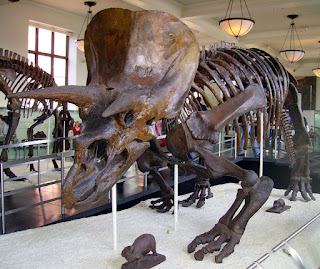
I grew up in a conservative Christian home. When my parents saw that I was interested in dinosaurs, they gave me a lot of creationist books on the topic. To be fair, my parents have always been more open-minded about origins than a lot of conservatives. The books, though, were written with a heavy anti-evolution agenda, and I think this is where my obsession with proving people wrong began. They filled me with wonder, though, and in a sense, they still do. Maybe plesiosaurs are swimming in the Mariana Trench, or what if triceratopses are hiding in jungles in Africa?

These books always went from dinosaurs to Genesis, and that's where my love of the stories in the first bit of Genesis began. I like imagining God carving oceans in the earth with his hands and scooping land together, and people living in an ideal garden, and how the world might have changed in a catastrophe. These stories in Genesis help me form meaning. I think that the idea of people being made in God's image is much more helpful for me than working out bioethics in making sense of modern moral dilemmas. That we are said to come from the dirt, but are pushed back into it by toiling as farmers helps me understand both the worth and the stress of my job.
I find so much meaning in the story of the fall. The blame-shifting, the hiding, the shame, I tell this story myself whenever I do wrong. When I was a small child, I would sit on the toilet, groaning as I pooped, asking, "Why did Adam and Eve have to eat the forbidden fruit?" I don't know that I felt at the time like that was unfair. I did feel like my pain was bound cosmically to the actions of naked strangers.
The sin of the people caused thorns and disease and everything that is not-good in the world. (More cynical people than I would complain of how this punishment is not proportional, or would blame God for putting the tree in the garden in the first place.) The problem that I have with the story of the fall is its placement of the weight of intentionality behind everything that's unseemly.

I've spent a lot of time and toil trying to find meaning in meaningless suffering. I think evolution tells a story that helps me deal with reality better. Creation says that everything used to be good, but humans messed it up, but God will make it okay again. Evolution says that everything used to be bland and dead, but that beauty has arisen naturally. The world isn't a bad place, the kinks just haven't been shaken out yet. For something that I didn't pay for, I think life in this cosmos is pretty nice, and if there's no intentionality behind it, I'd say things are working out pretty well, all things considered.

Life is tenacious. All beings are always changing, trying new ways to fit the world better. Evolution is incredibly messy, it's not an organized process. It's not the most efficient way one could conceive of that life could come to be. Natural history is riddled with false starts. There are oodles of examples of great successes, like dinosaurs, that lost whatever advantage they had and then disappeared. The plesiosaurs probably ran out of food.
Evolution doesn't say anything about what an ideal world would be or how we should live or what ultimate meaning is. What I learn from evolution is that life isn't neat, but that progress comes from trying a lot of things, most of which aren't going to work very well. If you stick with what does, and change it a little bit, and keep trying new things, you might wind up with something neat.
When I make mistakes, I think about evolution, and I smile. My mistakes aren't abysmal failures, they're just things that need tweaking, or dead-ends that can be abandoned in favor of five new ideas.
(I like snacks because they're extra food; they're food you eat because you want to, not because you need nourishment. I like furniture because it's a humble category; chairs are for people, cabinets are for dishes, desks are for papers. No furniture exists for itself. I like mistakes because they're things that you didn't do right that you don't have to feel bad about.)

I grew up in a conservative Christian home. When my parents saw that I was interested in dinosaurs, they gave me a lot of creationist books on the topic. To be fair, my parents have always been more open-minded about origins than a lot of conservatives. The books, though, were written with a heavy anti-evolution agenda, and I think this is where my obsession with proving people wrong began. They filled me with wonder, though, and in a sense, they still do. Maybe plesiosaurs are swimming in the Mariana Trench, or what if triceratopses are hiding in jungles in Africa?

These books always went from dinosaurs to Genesis, and that's where my love of the stories in the first bit of Genesis began. I like imagining God carving oceans in the earth with his hands and scooping land together, and people living in an ideal garden, and how the world might have changed in a catastrophe. These stories in Genesis help me form meaning. I think that the idea of people being made in God's image is much more helpful for me than working out bioethics in making sense of modern moral dilemmas. That we are said to come from the dirt, but are pushed back into it by toiling as farmers helps me understand both the worth and the stress of my job.
I find so much meaning in the story of the fall. The blame-shifting, the hiding, the shame, I tell this story myself whenever I do wrong. When I was a small child, I would sit on the toilet, groaning as I pooped, asking, "Why did Adam and Eve have to eat the forbidden fruit?" I don't know that I felt at the time like that was unfair. I did feel like my pain was bound cosmically to the actions of naked strangers.
The sin of the people caused thorns and disease and everything that is not-good in the world. (More cynical people than I would complain of how this punishment is not proportional, or would blame God for putting the tree in the garden in the first place.) The problem that I have with the story of the fall is its placement of the weight of intentionality behind everything that's unseemly.

I've spent a lot of time and toil trying to find meaning in meaningless suffering. I think evolution tells a story that helps me deal with reality better. Creation says that everything used to be good, but humans messed it up, but God will make it okay again. Evolution says that everything used to be bland and dead, but that beauty has arisen naturally. The world isn't a bad place, the kinks just haven't been shaken out yet. For something that I didn't pay for, I think life in this cosmos is pretty nice, and if there's no intentionality behind it, I'd say things are working out pretty well, all things considered.

Life is tenacious. All beings are always changing, trying new ways to fit the world better. Evolution is incredibly messy, it's not an organized process. It's not the most efficient way one could conceive of that life could come to be. Natural history is riddled with false starts. There are oodles of examples of great successes, like dinosaurs, that lost whatever advantage they had and then disappeared. The plesiosaurs probably ran out of food.
Evolution doesn't say anything about what an ideal world would be or how we should live or what ultimate meaning is. What I learn from evolution is that life isn't neat, but that progress comes from trying a lot of things, most of which aren't going to work very well. If you stick with what does, and change it a little bit, and keep trying new things, you might wind up with something neat.
When I make mistakes, I think about evolution, and I smile. My mistakes aren't abysmal failures, they're just things that need tweaking, or dead-ends that can be abandoned in favor of five new ideas.
Tuesday, July 14, 2009
I'm sorry that I'm obsessed with proving people wrong
There are two main apologetics strategies. One is to provide a rational defense of the faith, the other is to apologize for how terrible Christians are, in hopes that people would want to become Christians, themselves, as a result. I exclusively use techniques from the second category.
I blame no one but myself for this: I was the most obnoxious creationist that I've ever met, and I'm very sorry if you've ever been bored by my droning on about llamas and giraffes, or if I've offended you with my ignorance of biology (I've not studied it since seventh grade).
I was very interested in dinosaurs when I was a small child, and, as all young earth creationists know, dinosaurs are a Trojan horse for evolutionist propaganda. However, at age four, I was given a copy of The Great Dinosaur Mystery and The Bible, which shows, among other things, that a plesiosaur was caught by Japanese fishermen in the 1970's. Thus inoculated against evolutionary falsehood, I studied creationism, hoping to be able to prove wrong those evolutionists.
So, I harassed my evolutionist neighbor a few doors down, and her dad, and my history of science class in my junior year of college and a friend's roommate who majored in environmental science. I told them all about how 'ontogeny recapitulates phylogeny' is bunk—this has been well established for a long time, and it's a shame that these things are repeated in textbooks today, but that doesn't mean evolution's wrong. I speculated wildly about probabilities of abiogenesis. I was willfully ignorant of how radiometric dating actually works.
I don't mean to throw any creationist friends under the bus by what I'm writing here, I honestly don't mean to implicitly accuse them of anything. I own what I'm saying here for myself. I was a brat.
I think that some creationists get into the scuffles that they do out of genuine concern for others' souls. I might have had some element of that in me, but I really wanted to be right about something that the majority got wrong.
I was prideful and conceited to think that I just needed to read a couple of books, and I would be able to say something meaningful to mainstream science. I didn't stop there; I thought that I, personally, would be able to shake up mainstream science by calling it out for being deceptive—I thought I had that measure of honesty with myself, that I could be that persuasive. I thought that evolutionists just thought what they did out of delusion. I was wrong.
I still want to be right, to show up a lot of people that I disagree with; I just want to be right about different things now. I shouldn't have that attitude, that's wrong, and I'm sorry. Please forgive me.
I blame no one but myself for this: I was the most obnoxious creationist that I've ever met, and I'm very sorry if you've ever been bored by my droning on about llamas and giraffes, or if I've offended you with my ignorance of biology (I've not studied it since seventh grade).
I was very interested in dinosaurs when I was a small child, and, as all young earth creationists know, dinosaurs are a Trojan horse for evolutionist propaganda. However, at age four, I was given a copy of The Great Dinosaur Mystery and The Bible, which shows, among other things, that a plesiosaur was caught by Japanese fishermen in the 1970's. Thus inoculated against evolutionary falsehood, I studied creationism, hoping to be able to prove wrong those evolutionists.
So, I harassed my evolutionist neighbor a few doors down, and her dad, and my history of science class in my junior year of college and a friend's roommate who majored in environmental science. I told them all about how 'ontogeny recapitulates phylogeny' is bunk—this has been well established for a long time, and it's a shame that these things are repeated in textbooks today, but that doesn't mean evolution's wrong. I speculated wildly about probabilities of abiogenesis. I was willfully ignorant of how radiometric dating actually works.
I don't mean to throw any creationist friends under the bus by what I'm writing here, I honestly don't mean to implicitly accuse them of anything. I own what I'm saying here for myself. I was a brat.
I think that some creationists get into the scuffles that they do out of genuine concern for others' souls. I might have had some element of that in me, but I really wanted to be right about something that the majority got wrong.
I was prideful and conceited to think that I just needed to read a couple of books, and I would be able to say something meaningful to mainstream science. I didn't stop there; I thought that I, personally, would be able to shake up mainstream science by calling it out for being deceptive—I thought I had that measure of honesty with myself, that I could be that persuasive. I thought that evolutionists just thought what they did out of delusion. I was wrong.
I still want to be right, to show up a lot of people that I disagree with; I just want to be right about different things now. I shouldn't have that attitude, that's wrong, and I'm sorry. Please forgive me.
Thursday, June 12, 2008
Evolution for Creationists
Darwin's finches don't ruffle creationist's feathers. They really ought not. What Darwin saw was what creationists call microevolution, adaptation due to genetic drift and natural selection. I've never met a creationist who denies this. I've never even met a creationist that doesn't know that mutation occurs, but they do say that beneficial mutations do not occur enough for macroevolution--what they call the formation of new species.
Modern biology doesn't even make the distinction between macro- and microevolution, which is appropriate, in terms of developing the science. However, this is harmful in talking with creationists, because most of the cases of evolution cited by evolutionists creationists explain in terms of microevolution.
One time, when Matthew and I were young earth creationists, we showed up late at a talk and discussion on evolution on campus. I asked the speaker for an example of evolution; her work is in physical anthropology, so she talked about the proliferation of genes tied to schizophrenia. Never mind that schizophrenia is a bad thing, unlikely to sell evolution; when we asked her if we could tell at one point the genes for schizophrenia were not there, and then they were, we got an answer about how the genes spread, when we were really interested in knowing if new genetic information had been introduced. This just made us more convinced creationists, because she didn't even realize what we disagreed with her on. Ironically enough, Matthew and I saw this as a cop-out fueled by cognitive dissonance. Then, we talked until late at night about complementarianism, but that's another story.
A recent article in New Scientist helps refute creationism by addressing its actual claim: that helpful mutations do not occur enough to form new species. The article talks not about a whole new species, but it does talk about how, in the lab, a biologist, Richard Lenski observed a beneficial new gene occur by mutation in e. coli, where it hadn't been before--macroevolution. The ones after a certain point had a mutation that allowed them to metabolize citrate, while the ones before this point didn't have that gene. Bob Holmes, the author of the article, did an amazing job of explaining exactly what happened, so that the creationist dismissal of macroevolution does not hold.
Wednesday, February 6, 2008
The Shady Side of Wisdom
In a previous post, I mentioned the article The Shady Side of Wisdom by George Mendenhall. In this article, Mendenhall uses linguistic evidence to demonstrate a late date of authorship for the first few chapters of Genesis, and exegetes the text in that cultural context. The major conclusion of this paper, that I was referring to, is not just that Genesis 1-3 can be read figuratively, but that reading them literally does injustice to the text, because a literal reading was not intended. If you want a copy of the article, let me know.
Friday, February 1, 2008
Talking about Creationism
Creationism, young earth creationism especially, makes me mad.
Creation science is a misnomer. Anywhere on the creation spectrum, from young earth creationism to intelligent design, the bulk of time, energy, and money is going into trying to work politically to get creationism taught in public schools, and in efforts at creation science evangelism. Very little real science work -- gathering data, doing experiments, and analyzing the data as part of the mainstream scientific community -- is being done.
When Christians leave a gospel tract instead of a tip at a restaurant, or when we bug out co-workers about Jesus, but show up at work late and take long lunch breaks, we're unable to proclaim the gospel with words, because we're saying the exact opposite without them. In precisely the same way, why ought we expect responsible, methodical, hard-working scientists to listen to Christians when creationists throw spurious, ill-posed, ignorant arguments at them?
At the same time, the mainstream academic community hasn't done much to address creationist fallacies directly. If you went to Barnes and Noble, thinking, say, "I heard that the earth must be young because its magnetic field is decaying so quickly, but I want to see what mainstream science has to say about this claim," you wouldn't be able to find a book that directly addresses that statement.
I know that a hefty chunk of my readers are somewhere on the creationist spectrum. I'd like to do a series of blog posts specifically addressing the issues you raise with cosmic origin, abiogenesis, the age of the earth, and evolution. Also, I'm quite sure that the major reason why creationists are creationists is not that they are compelled to believe as they do from the science, but, first, because they want to take Genesis seriously. However, I think that there's a distinction between taking Genesis seriously and taking it literally, and I'd like to talk about that some, too.
Here's are some questions I have for you:
Creation science is a misnomer. Anywhere on the creation spectrum, from young earth creationism to intelligent design, the bulk of time, energy, and money is going into trying to work politically to get creationism taught in public schools, and in efforts at creation science evangelism. Very little real science work -- gathering data, doing experiments, and analyzing the data as part of the mainstream scientific community -- is being done.
When Christians leave a gospel tract instead of a tip at a restaurant, or when we bug out co-workers about Jesus, but show up at work late and take long lunch breaks, we're unable to proclaim the gospel with words, because we're saying the exact opposite without them. In precisely the same way, why ought we expect responsible, methodical, hard-working scientists to listen to Christians when creationists throw spurious, ill-posed, ignorant arguments at them?
At the same time, the mainstream academic community hasn't done much to address creationist fallacies directly. If you went to Barnes and Noble, thinking, say, "I heard that the earth must be young because its magnetic field is decaying so quickly, but I want to see what mainstream science has to say about this claim," you wouldn't be able to find a book that directly addresses that statement.
I know that a hefty chunk of my readers are somewhere on the creationist spectrum. I'd like to do a series of blog posts specifically addressing the issues you raise with cosmic origin, abiogenesis, the age of the earth, and evolution. Also, I'm quite sure that the major reason why creationists are creationists is not that they are compelled to believe as they do from the science, but, first, because they want to take Genesis seriously. However, I think that there's a distinction between taking Genesis seriously and taking it literally, and I'd like to talk about that some, too.
Here's are some questions I have for you:
- Where on the creation spectrum, from young earth to atheistic evolution, do you land?
- Do you use arguments relating to creation when you do apologetics?
- What are your reasons, scientific and theological, for believing as you do?
Tuesday, July 24, 2007
Why arguing for creationism is, in my opinion, ill-advised
Some time ago, I explained why I think that arguing in favor of Intelligent Design is almost completely misguided; rather than suggesting that ID is false, I said that only a very few people are even qualified to have such a discussion. In response, crooked deep down wrote
Young earth creationism attempts both, but fails altogether, because it is deeply incongruous with astronomy, geology, paleontology, paleoanthropology, and archeology, even when just considering the contention that the earth is 6,000 years old (or so). The talk.origins FAQ is the best place to start that I've found.
As far as the science of it is considered, I think creationism is pretty dumb, but I prefer not to think ill of creationists (exception: Kent Hovind). For the most part, creationism makes sense, if you've mostly been exposed to creationist literature. I think of creationism like I think of urban legends, people believe because people they trust believe, and that's completely reasonable, most of the time.
I don't think that belief in YEC is neutral; I think that it is destructive because of how it misrepresents nature and falsely engenders distrust in the scientific process. One example of how YEC harbors misinformation is in crooked's response:
Yes, the earth's magnetic field is currently weakening. This is normal. The contention that the earth can't be much older than 10,000 years depends on the assumption that that the magnetic field has been weakening monotonically, that is, that it has always been weakening. This is simply a very bad assumption; we know that the magnetic field, rather than decreasing steadily, fluctuates periodically, this is called geomagnetic reversal.
We know that geomagnetic reversals have taken place, many times, from several pieces of evidence, namely variation in magnetic polarity in adjacent rock layers. For example, at places where new rock forms continuously, like at the mid-Atlantic ridge, the magnetic polarity of a bit of the rock is like a snapshot of the earth's magnetic field from when that bit of rock was formed. Measurements like this actually confirm the geomagnetic reversal theory, and emphatically point to an old age for the earth.
If I had a friend who was considering becoming a Christian, but felt as if the Genesis account of creation didn't match with science, rather than teach him YEC, I'd instead tell him that Genesis 1-3 was actually written to be understood as myth. George E. Mendenhall's article, "The Shady Side of Wisdom" provides a good explanation of this. (This article is very difficult to find; if you want a copy, ask me.)
Mendenhall demonstrated from linguistic analysis that the text had a late date of authorship, based on the use of certain words that are relatively new. This, alone, doesn't take away from the understanding of the Genesis account as inspired, we just need to read it as an inspired myth that tells us much about who we are and who God is, but not so much about actual history. This isn't even a new idea, Augustine, among others, thought of Genesis 1-3 as basically mythical.
This is what I'd tell a friend considering becoming a Christian.
I hope that I walked the line between calling YEC the way I see it, but not being mean to my creationist readers. If you want to talk, well, origins, check the talk.origins FAQ first, then drop a comment.
However, wouldn't you say that, for some people, what they perceive to be incontrovertible scientific evidence against the Bible is a fence that keeps them from loving Jesus, and we can help them along in their journey if we can knock a hole in that fence?It's important to remember that crooked is a young earth creationist, so the discussion is completely re-framed, we need to distinguish between three positions:
- Young earth creationism
- Theistic evolution (ID)
- Atheistic evolution
- To convince somebody to accept Jesus
- To reassure yourself that the Bible isn't inauthentic
Young earth creationism attempts both, but fails altogether, because it is deeply incongruous with astronomy, geology, paleontology, paleoanthropology, and archeology, even when just considering the contention that the earth is 6,000 years old (or so). The talk.origins FAQ is the best place to start that I've found.
As far as the science of it is considered, I think creationism is pretty dumb, but I prefer not to think ill of creationists (exception: Kent Hovind). For the most part, creationism makes sense, if you've mostly been exposed to creationist literature. I think of creationism like I think of urban legends, people believe because people they trust believe, and that's completely reasonable, most of the time.
I don't think that belief in YEC is neutral; I think that it is destructive because of how it misrepresents nature and falsely engenders distrust in the scientific process. One example of how YEC harbors misinformation is in crooked's response:
For example, we might say that much-touted radiometric dating relies on a lot of assumptions that might not be true, or the whole thing with the decay of the earth's magnetic field being seemingly incongruous with an Earth much older than 10,000 years.Again, I don't suspect any malice or evil on the part of crooked, or on the part of whoever told him that, but this is a good example of how YEC, like an urban legend or conspiracy theory, shows part of the information to produce misunderstanding of the whole.
Yes, the earth's magnetic field is currently weakening. This is normal. The contention that the earth can't be much older than 10,000 years depends on the assumption that that the magnetic field has been weakening monotonically, that is, that it has always been weakening. This is simply a very bad assumption; we know that the magnetic field, rather than decreasing steadily, fluctuates periodically, this is called geomagnetic reversal.
We know that geomagnetic reversals have taken place, many times, from several pieces of evidence, namely variation in magnetic polarity in adjacent rock layers. For example, at places where new rock forms continuously, like at the mid-Atlantic ridge, the magnetic polarity of a bit of the rock is like a snapshot of the earth's magnetic field from when that bit of rock was formed. Measurements like this actually confirm the geomagnetic reversal theory, and emphatically point to an old age for the earth.
If I had a friend who was considering becoming a Christian, but felt as if the Genesis account of creation didn't match with science, rather than teach him YEC, I'd instead tell him that Genesis 1-3 was actually written to be understood as myth. George E. Mendenhall's article, "The Shady Side of Wisdom" provides a good explanation of this. (This article is very difficult to find; if you want a copy, ask me.)
Mendenhall demonstrated from linguistic analysis that the text had a late date of authorship, based on the use of certain words that are relatively new. This, alone, doesn't take away from the understanding of the Genesis account as inspired, we just need to read it as an inspired myth that tells us much about who we are and who God is, but not so much about actual history. This isn't even a new idea, Augustine, among others, thought of Genesis 1-3 as basically mythical.
This is what I'd tell a friend considering becoming a Christian.
I hope that I walked the line between calling YEC the way I see it, but not being mean to my creationist readers. If you want to talk, well, origins, check the talk.origins FAQ first, then drop a comment.
Saturday, April 21, 2007
Why arguing intelligent design is unproductive
I grew up reading many books on how to argue creationism, to defend the faith from the evolutionists. When I got to college, I saw that arguing creationism wasn't working at all. This was very strange, because I knew all the arguments. What I didn't realize for a very long time is that science interprets itself. Science is a communal endeavor, and it grows through discussions, not arguments. The standard of truth in science is now basically postmodern.
Science is very different now than it was a hundred years ago; it is staggering under its own weight. Science has become a community of specialists. About a half a dozen people in the world understand what it is that I'm doing for my research right now, and why it's important. If anyone outside of that very small group wanted to double-check my work, it would probably take him weeks of reading old journal articles, doodling on marker boards, asking questions, and messing about with computer simulations written in Fortran.
When articles that I write go up for peer review, the validity of my work is considered by some of the few people who can actually understand it. The confidence that scientists outside that circle can place on my work rests on the trustworthiness of my reviewers. In short, scientific truth is determined by the community. This is a postmodern standard of truth.
We scientists would like it if everything we knew in science could be reasoned from first principles, or tested quickly and easily in a lab setting. We don't want to have to use a postmodern standard of truth, but we have little choice. It's not quite so bad as it sounds; because science is based on experimentation, observation, and reason, it doesn't become unhinged from reality nearly as quickly as disciplines which are based more on opinion and ideology. And science works; we've sent astronauts to the moon, our life expectancies are much improved over what they were a hundred years ago, and I can buy a pizza for a dollar and cook it in four minutes.
If I, as an individual, were to argue against the consensus of the entire scientific community, I would be presumptuous. Thomas had the luxury of being able to touch the holes in Jesus' hands and feet, and the wound in his side; then he could believe. The scientific community is composed of people who are as skeptical as Thomas, but, when it comes to theory of origin, the evidence is not as plain to us as it was to Thomas. No one person can understand biochemistry in sufficient detail to be able to consider whether it is probable that even a single cell came about by chance. When it comes to problems that require such a high degree of specialization, it is unreasonable to expect a scientist to take my word over that of the community.
Science is very different now than it was a hundred years ago; it is staggering under its own weight. Science has become a community of specialists. About a half a dozen people in the world understand what it is that I'm doing for my research right now, and why it's important. If anyone outside of that very small group wanted to double-check my work, it would probably take him weeks of reading old journal articles, doodling on marker boards, asking questions, and messing about with computer simulations written in Fortran.
When articles that I write go up for peer review, the validity of my work is considered by some of the few people who can actually understand it. The confidence that scientists outside that circle can place on my work rests on the trustworthiness of my reviewers. In short, scientific truth is determined by the community. This is a postmodern standard of truth.
We scientists would like it if everything we knew in science could be reasoned from first principles, or tested quickly and easily in a lab setting. We don't want to have to use a postmodern standard of truth, but we have little choice. It's not quite so bad as it sounds; because science is based on experimentation, observation, and reason, it doesn't become unhinged from reality nearly as quickly as disciplines which are based more on opinion and ideology. And science works; we've sent astronauts to the moon, our life expectancies are much improved over what they were a hundred years ago, and I can buy a pizza for a dollar and cook it in four minutes.
If I, as an individual, were to argue against the consensus of the entire scientific community, I would be presumptuous. Thomas had the luxury of being able to touch the holes in Jesus' hands and feet, and the wound in his side; then he could believe. The scientific community is composed of people who are as skeptical as Thomas, but, when it comes to theory of origin, the evidence is not as plain to us as it was to Thomas. No one person can understand biochemistry in sufficient detail to be able to consider whether it is probable that even a single cell came about by chance. When it comes to problems that require such a high degree of specialization, it is unreasonable to expect a scientist to take my word over that of the community.
Subscribe to:
Posts (Atom)