Lauren, who recently found my blog and contacted me, is now writing at The Process Of Leaving about her process in leaving the church. I think that readers of this blog may find her account interesting; she's describing how she feels as she has conversations with people that are important to her as she leaves.
Friday, June 3, 2011


Tuesday, May 17, 2011
New blog
This blog is closed now. I'm now writing at Alex's blog. Please update your RSS readers and bookmarks accordingly. A little bit of explanation is at my website, which is the best source for what sort of web things I'm working on. This site will stay open, but will no longer be updated.
Tuesday, May 3, 2011
The celebration of the killing of Osama bin Laden
I am more scared by America celebrating the killing of a human than I ever was scared by al Qaeda. I saw at the top of the first news article I found after Osama bin Laden was killed:
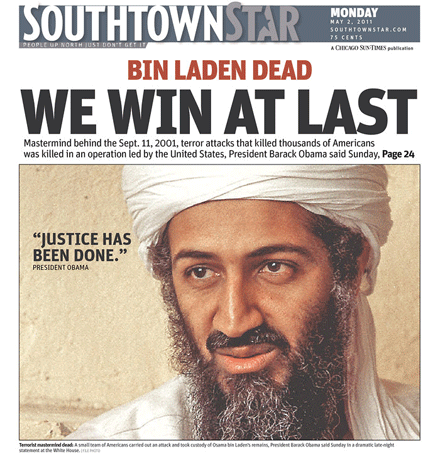
"Justice has been done," President Barack Obama declared late Sunday as crowds formed outside the White House to celebrate. Many sang "The Star-Spangled Banner" and "We Are the Champions."
Alexis Madrigal has a piece I recommend, describing the crowd behavior in front of the White House upon the announcement. Chanting “U-S-A U-S-A” and singing “We are the champions” is appropriate for a hockey game. Mass expressions of sentiment rarely demonstrate self-esteem and objective moral reasoning.
From President Obama’s address:
So [Bin Laden’s] demise should be welcomed by all who believe in peace and human dignity.
I do not welcome demises.
And on nights like this one, we can say to those families who have lost loved ones to al Qaeda's terror: Justice has been done.
Justice has been done when we have killed the guy who killed some of us.
Yet today's achievement is a testament to the greatness of our country and the determination of the American people.
Killing is not an achievement. It is not great. We Americans grow corn, we invent things, we take care of the sick, we write and paint and we love—these are great achievements. Killing an enemy is, at best, a solemn shame. It’s one thing to approve of the killing of another human being, to decide to strip him of his life. To celebrate a killing is to attempt to strip a human of his humanity.
We recoil when other people harm other people, especially children, we recoil at corpses, at the ill, at the aged, at people who observe different customs. Whenever I have shaken hands with a homeless person, I have felt the urge to wash my hands; my conscience has difficulty telling the difference between disease and poverty. Osama bin Laden was an outsider to mainstream Americans, rich, Muslim, middle-eastern, so we ought to pause to separate the parts of our response that pertain to the harm Bin Laden caused from the parts that pertain to the alienness we feel towards him. Human beings get self-esteem from identification with a group, a culture, a nation, a hockey team, and cheering at Bin Laden’s death is an activity which has more to do with group identification than with determining justice. We need to be able to distinguish between “Osama bin Laden was killed,” “Justice has been done,” and “We won”.
In his speech, Obama noted, “No Americans were harmed.” All humans have equal moral standing, regardless of their citizenship or nationality. A moral cosmopolitan, here, would identify that one civilian, a woman, used as a human shield, was killed. This is sad.
After Jared Loughner shot several people, including Representative Gabrielle Giffords, it was noticed that Sarah Palin had a map with crosshairs on Giffords, and I blogged about it. There is no evident connection between Palin’s map and Loughner’s actions. I wish I hadn't used a violent act as an opportunity to make my own points about my own political views.
I anticipate that people are now writing columns and essays, arguing that the killing of Osama bin Laden is proof that the wars in Iraq and Afghanistan are or are not justified and that Barack Obama is better or worse than George W Bush. Many of these will mention that it is ironic that Bin Laden was killed eight years to the day after Bush’s “Mission Accomplished speech”. This is also good opportunity for Obama fans to mock Donald Trump for being concerned with trivialities.
I doubt that many of these essays will change minds. They will, instead, make people feel more reassured of their own views. We can get self-esteem by hating Osama bin Laden, and we can also get it by hating Fox News or hippies or the Democrats.
Americans are afraid. Celebrating killing normalizes killing and homogenizes thinking. People who are powerful and afraid and united and upset are dangerous, and this scares me.
Appendix
Proverbs 24:17 "Rejoice not when thine enemy falleth, and let not thine heart be glad when he is overthrown."
The Onion: Violent Death Of Human Being Terrific News For Once
An example of point-scoring:
 |
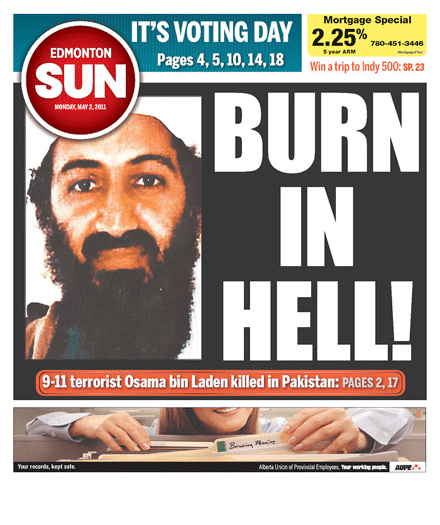
Newspaper front pages, collected by Julie Moos at Poynter:


Tuesday, April 26, 2011
On "Sunday"
Yesterday, I wondered whether Christians had made a parody of Rebecca Black's Friday, and called it Sunday. They had. I expected it, like most Christian knock-offs, to be bad. It was worse.
Now, I'm not expecting high art or deep theology from a parody of Friday. What struck me first about Sunday was, of course, the excessive poppiness of the song; I'm too much of a grouch to enjoy music that tries to make me like it. What sticks with me, though, is this: God gets mentioned once.
Friday and Sunday both have very high production values: this isn't stuff made by a couple of teenagers with a Flip. Friday was produced by Ark Music Factory, backed by Black's parents.
Who was behind Sunday?
Sunday was made by Community Christian Church, a megachurch near Chicago, as a plug for their Easter services. The ideal audience is potential visitors. Sunday functions as a commercial for a religious institution, with only incidental mention of the Deity himself. This is characteristic of the church acting as an organization seeking to promote its own existence, rather than acting for another goal. What's promoted is the fun times, the "Worshippin', Worshippin' (Yeah)". The lyrics apologize for other churches, “Fun, fun, church can be fun.” It doesn’t say anything about love or release from guilt or a relationship with God being a source of joy.
When I was in high school, I went to a church that had a logo. Ushers got polo shirts with the logo embroidered, church-branded coffee cups and frisbees were given away. My church was unconcerned with social justice. Evangelism that would lead to more church members was much more discussed than remote missionary work. So I made like a self-righteous eighteen-year-old and quit.
And now, as an atheist, I am still bothered when the church focuses on things other than loving God and loving people. If I want to hear a good band, I’ll go to a concert and if I want good psychology, I’ll talk to my counselor. When I go to church, I want religion; I want Christians to engage with their idea of God: I’ll have something to learn from contemplating with them or by thinking about why I disagree with them.
Wednesday, March 16, 2011

Tuesday, March 15, 2011
On "Why Are Atheists So Angry?"
Rabbi David Wolpe wrote Why are Atheists so Angry; in it, he lists four reasons why he thinks that atheists are angry. He opens discussing how a lot of the feedback he gets on his writing on the Internet is from atheists and that they are generally angry. His four points are clearly applicable to the sort of atheists who write angry things in blog comments, but it seems to me that he didn't actually ask an atheist friend if he's angry, and, if so, why. I want to mention, here, two things in his article that make me angry.
Atheists are angry because we are members of a cultural out-group. We're not in as bad of a situation as, say, racial minorities, in that we have the choice to keep our mouths shut. We're are an out-group, though. How many atheist characters do you see on TV? I can think of Dr House; House is a stereotypical atheist, grouchy, rationalist, cynical. Dr Cameron on the same show is also a nonbeliever; she's a more sympathetic character and I wish people would notice her more. No other characters come to mind at the moment. Of course, most characters on TV don't make mention of their religious beliefs, but I wish I saw atheist characters on TV dealing with the issues I deal with, things like negotiating friendships with religious people. When people deconvert, increased tension with parents is common, and I didn't find many portrayals of people in the same situation in any media.
People treat out-group members poorly. I've heard religious people say that my worldview is meaningless, that it leads to gulags, that atheists can't have authentic systems of morality, that we're disingenuous in shutting out a belief in the supernatural—these things hurt. (I'm not saying that Wolpe makes all of these accusations against atheists.) I think Rabbi Wolpe can relate to me in this struggle: Jews have dealt with centuries of mistrust by the majority in Western culture, examples of this include blood libel and the stereotype that they are greedy. It hurts to be excluded and it hurts to be blamed.
Alienation is a frequent topic of conversation for atheists, for example, we talk the difficulty in "coming out" about our nonbelief. That Rabbi Wolpe doesn't mention alienation as a cause of anger for atheists makes me think that he wrote an article about why we're angry without directly consulting any of us; this sort of presumption makes me angry.
The other thing that Rabbi Wolpe says that makes me angry is his assertion atheists sometimes have a "want of wonder". I'm a scientist, and most of my atheist friends major in the sciences; I want to talk concretely about wonder for atheists who are scientists in particular. Scientific work leads to useful knowledge, but the process of doing science is fraught with uncertainty. I don't know if my code has a bug in it or how reliable measurements of cells in the literature are. Last week, a colleague presented experimental data and was criticized for the large variance in it. About a quarter of my job is learning new things by reading, and another quarter is learning new things by doing my own studies. It's hard work and it matters to me because I think cells are amazing and I want to know more about them. It's fiendishly difficult to describe the physics of the matter inside cells and I marvel at the possibilities in this and I enjoy following the lively and constructive debate about how to approach this problem.
The difference between research and homework is that no one has done a particular research project before; there's an Einstein quote floating around, "If we knew what we were doing, it would not be called research, would it?" The job of scientists is to live at the edge of what we don't know and we can't like our jobs unless we are willing to wonder. (This applies to all scientists, not just atheists.)
Atheists aren't necessarily stodgy, we just look for the unknown in things that can be studied, rather than beyond the material world. There is enough to wonder about here.
I want to mention that I agree with his first point, that atheists particularly notice suffering caused by religion, and that he's willing to let religion take the hit on this. Most of his points seem to apply to the atheists that argue with him on the Internet, but they don't uniformly fit most atheists, or at least not the ones I know personally. I don't really have a grudge against Rabbi Wolpe, but his essay touched a nerve. I'm glad he's talking about this stuff and I think he's open to listening.
Tuesday, February 8, 2011
On "Life as a Leaver"
In Anna Scott's Life as a Leaver, she articulates the painful effort needed to withstand doubt and judgment. Her husband divorced her, and this suffering led her to doubt. She has been, and is, pursuing a career in ministry, and as someone concerned with being theologically orthodox, she faces the belief on the part of a lot of her fellow church members that, because she is a woman, she isn't fit to serve in the capacity she feels called to. Life as a Leaver is ostensibly in response to The Leavers: Young Doubters Exit the Church by Drew Dyck, but her article stands on its own.
Although Scott will likely remain a believer, as a doubter she certainly has my sympathies. She describes the pat answers she gets, and the frustration of realizing that the intellectual understanding she had of God's love through suffering, that understanding was not as solid as she expected. I recommend reading her article for its frankness and the all-too-rare "I don't know" from a thoughtful religionist:
Surely, I am not the only person to have “crashed” on these “rocks” of sin and suffering, sovereignty and certainty. And I no longer think that it is a sign of immaturity or ignorance that these rocks give birth to doubt; in fact, I think it is immature and ignorant to deny these very real questions: about rape, about mental illness, about earthquakes, about affairs, about divorce, about children born into extreme poverty. Where does sovereignty end and sin begin? And what does that say about God? Shouldn’t this be relevant to any discussion of disbelief?
In Dyck's article, he says:
Over the past year, I’ve conducted in-depth interviews with scores of ex-Christians. Only two were honest enough to cite moral compromise as the primary reason for their departures. Many experienced intellectual crises that seemed to conveniently coincide with the adoption of a lifestyle that fell outside the bounds of Christian morality.
Moral compromise was not a factor in my departure from belief in God, and, if Dyck were to interview me, it would be dishonest of me to cite it as a reason for leaving. The part of Scott's response that was the most relatable for me was:
I want to end this litany of criticisms [of Dyck's article] by acknowledging a point that I found both offensive and mildly insightful, but for different reasons than Dyck identifies: I do think that moral compromise plays a role in a person’s decision to leave Christianity, but I think that the negative influence is actually exerted on the developing doubter, rather than on the moral transgressor. Having attended youth group religiously (yes, I am going with this idiom despite the pun) and a prominent Christian college, followed by years in communities, churches, faith-based organizations and Christian graduate school, I can easily attest to the willingness—even eagerness—of young evangelicals to compromise biblical standards and call it doubt or rebellion. But, sooner or later, these people will find a nice Christian husband or wife and return to the church of their childhood, because doubt is not their real issue. It is those of us who are trying to build a thoughtful, substantive, deep faith who observe this behavior in young people raised in the church and wonder what has gone wrong. What the hell is going on here? I often asked myself, observing this profound lack of authenticity. Why do these people—and, in all honestly, I became one of them in college—bother retaining the trappings of Christianity at all?
As I was doubting, I became more scrupulous in my moral behavior. Knowing that good works could not save me, and that my good behavior might be some vain attempt to pacify God, I tried to find the right spiritual muscles to flex, the ones involving humility and submission and resignation. I was afraid to sin, or even, to have a wrong spiritual inclination, because that would be an indicator that my doubts were inauthentic: perhaps I was doubting my way out of my moral obligations or the challenge of relating to God. I didn't want my honest doubts to be dismissible by others or myself as mere moral compromise. Scott is right in noting that others' moral failings are as likely to lead to doubt as one's own foibles, and right in noting the wrongness of looking to blame doubters. If there were a badge to give to Christians for being relatable to nonbelievers, she gets it.
Tuesday, February 1, 2011
Response to bittersweet and brave
The following is a comment on Matthew's brave and bittersweet; this is part of an ongoing conversation outlined here regarding secular hope. Here, I want to respond to a couple of points that Matthew raised in brave and bittersweet.
Previously, I posed the question:
Which is the better source of hope: this world, small, and often backwards as it is, but certain, or transcendent meaning and eternal life, known by invisible evidence? What can comfort?
This question is clearly answered differently by different people. I suppose that a lot of people believe that meaning and security and comfort can only be had if there is a God, a promise of heaven, and the assurance that God is acting on the world now. Not everyone wants these beliefs or finds them helpful, though.
Matthew wrote:
A secular hope is a great thing for educated people who have the resources to avoid most of the pain and insecurity that come with disease, hunger, war, and oppression.
Secularism tends to skew more towards people who are well off. That doesn't mean it's inaccessible to people who are suffering. I have been reading lately about the Pirahã people in Brazil, hunter-gatherers who have no concept of God or spirits; life is not easy for them. More broadly, when it comes to existential beliefs, polytheisms tend to have more in common with atheism than they do with monotheisms; people can have supernatural beliefs but be functionally very similar to atheists in their outlook. Ancient Mesopotamian religions were fatalistic; the people believed that gods existed, but were cruel or indifferent or capricious. My understanding is that the structure of their outlook is common among agrarian civilizations. It is not apparent to me that it is the nature of human beings to either expect a paternal God, or to be despondent and hopeless without this belief. It's important to not provide pat answers, certainly, and the beliefs of privileged people regarding suffering are often unhelpful to the poor and oppressed, sick and alienated; this goes for both religious and secular beliefs about suffering.
Matthew mentions that secular concepts of hope are limited in two ways in particular: in secular concepts of meaning, everything is temporary, and everything is relative. These are both good points, and I recommend bearing both in mind. Yet, we don't call bread bad because it gets moldy, or because we get hungry again after eating it, or because there's better bread out there somewhere. Bread is precisely as big as bread is, and I'm glad I have enough bread for today.
Matthew compares secular hope to a lottery ticket and religious hope to the assurance that comes from adoption by a rich man. Belief in justice or wholeness or relief coming from a spiritual domain seems, to me, to be like buying a lottery ticket: there is an offer of infinite payoff, but the factual support for this hope is tenuous. Devout religious people don't live thoroughly consistently with their beliefs because it is difficult for humans to have the spiritual imagination to accept that God's will is perfect and in their interest; spiritual imagination is needed because their confidence is from faith in unseen things. When I say that hope from the material world is certain, I mean that we know for sure that this world exists and that there are things in it that give us some comfort and happiness and security. These things are small and limited and they wear out, but they are what we have for today. This materialist sense of hope can't stop death, it can't eliminate suffering, but it can sustain life for a little while. It's like farming, with modest yields coming from hard work. Sometimes there is plenty of rain, and sometimes there's drought. I can't offer a solution that will eliminate suffering or even death, or something that can transcend them, but adversity can be encountered with courage and dignity.
As I read both Andy Crouch's article and Matthew's post, I found myself unconvinced that my sense of hope is lacking, not because their logic was explicitly wrong, but because I myself feel fulfilled and secure, and I feel like I respond to the small challenges I face in a way that I am content with. I don't feel a need that they say that I should feel. I know that I'm not alone in not feeling a need for a belief in God in order to have a satisfying life in this world.
Friday, January 28, 2011
Links to share regarding secular hope
Matthew and I have been discussing ideas about secular hope over the past few weeks, and I want to point to his side of the discussion here. I suppose these discussions started with some talk on Twitter, which is a terrible venue for discussing serious matters at length. Written up in essay form, in chronological order, are:
- My Regarding that XKCD comic
- Matthew's also regarding that xkcd comic
- My On "A World Without Jobs", and, implicitly, Obama's speech at Tucson
- Matthew's brave and bittersweet
If you have thoughts to share, either comment, or blog something and send one of us a link.
Tuesday, January 25, 2011
On "A World Without Jobs", and, implicitly, Obama's speech at Tucson
Andy Crouch wrote A World Without Jobs in response to Steve Jobs, CEO of Apple, announcing that he is taking medical leave. Crouch, he contrasts the hope offered by Steve Jobs' "secular gospel" with Barack Obama's expression of hope in his recent speech at Tucson after the shooting there. Jobs' gospel, according to Crouch, is technological progress and courage in the face of death found in a meaningful life here and now. (Jobs' thoughts on the matter are expressed well in his commencement address at Stanford; I recommend watching this.) Jobs, on death:
No one wants to die. Even people who want to go to heaven don’t want to die to get there. And yet death is the destination we all share. No one has ever escaped it. And that is as it should be, because death is very likely the single best invention of life. It’s life’s change agent; it clears out the old to make way for the new. Right now, the new is you. But someday, not too long from now, you will gradually become the old and be cleared away. Sorry to be so dramatic, but it’s quite true. Your time is limited, so don’t waste it living someone else’s life. Don’t be trapped by dogma, which is living with the results of other people’s thinking. Don’t let the noise of others’ opinions drown out your own inner voice, heart and intuition. They somehow already know what you truly want to become.
Crouch says, in response:
Upon close inspection, this gospel offers no hope that you cannot generate yourself, and only the comfort of having been true to yourself. In the face of tragedy and evil it is strangely inert. Such a speech would have been hard to take at the funeral of Christina Taylor Greene, nine years old, killed along with five others on a bright Saturday morning in Tucson, Arizona. It is no wonder that Barack Obama, who had to address these deeper forms of grief this past week, turned to a vision which only makes sense if there is more to the world than we can see. Anything less is cold comfort indeed.
Which is the better source of hope: this world, small, and often backwards as it is, but certain, or transcendent meaning and eternal life, known by invisible evidence? What can comfort? In Obama's speech at Tucson, he presents both of these ideas of hope, and this is most apparent in his remembrance of Christina Taylor Green, the nine-year-old who was killed in the shooting. First, the secular hope:
I believe we can be better. Those who died here, those who saved lives here—they help me believe. We may not be able to stop all evil in the world, but I know that how we treat one another is entirely up to us. I believe that for all our imperfections, we are full of decency and goodness, and that the forces that divide us are not as strong as those that unite us.
That's what I believe, in part because that's what a child like Christina Taylor Green believed. Imagine: here was a young girl who was just becoming aware of our democracy; just beginning to understand the obligations of citizenship; just starting to glimpse the fact that someday she too might play a part in shaping her nation's future. She had been elected to her student council; she saw public service as something exciting, something hopeful. She was off to meet her congresswoman, someone she was sure was good and important and might be a role model. She saw all this through the eyes of a child, undimmed by the cynicism or vitriol that we adults all too often just take for granted.
I want us to live up to her expectations. I want our democracy to be as good as she imagined it. All of us—we should do everything we can to make sure this country lives up to our children's expectations.
Contrast this with his more symbolic and religious appeal to hope:
Christina was given to us on September 11th, 2001, one of 50 babies born that day to be pictured in a book called "Faces of Hope." On either side of her photo in that book were simple wishes for a child's life. "I hope you help those in need," read one. "I hope you know all of the words to the National Anthem and sing it with your hand over your heart. I hope you jump in rain puddles."
If there are rain puddles in heaven, Christina is jumping in them today. And here on Earth, we place our hands over our hearts, and commit ourselves as Americans to forging a country that is forever worthy of her gentle, happy spirit.
May God bless and keep those we've lost in restful and eternal peace. May He love and watch over the survivors. And may He bless the United States of America.
(Emphasis mine.)
Crouch closes his article:
Steve Jobs’s gospel is, in the end, a set of beautifully polished empty promises. But I look on my secular neighbors, millions of them, like sheep without a shepherd, who no longer believe in anything they cannot see, and I cannot help feeling compassion for them, and something like fear. When, not if, Steve Jobs departs the stage, will there be anyone left who can convince them to hope?
The question of what is the better hope to offer someone who is suffering, "Certain goodness in the material world, though modest and mixed, or possible perfection from above?", this question is an empirical one, if subjective. I offer for consideration my story as a case. As I was deconverting, finding the claims of Christianity to be dubious, I was upset at the loss of the hope from heaven, hope for a better life in eternity, and hope for justice in this world; the loss of these beliefs was the most painful element of my doubt. I don't miss these at all now, though, and I shudder when people like Andy Crouch say that I should feel like my worldview offers only "cold comfort"; I don't need his compassion and I don't need him to fear for me on account of my naturalist worldview, and I find these offers condescending.
Since I accepted my nonbelief, about a year and a half ago, I've been consistently happy in a way that I haven't been since I was a kid. I have a rabbit and I enjoy chili and reading books and doing my job and going to the beach with friends. Jobs' commencement speech reminds me of the motto, memento mori, remember to die. I understand that my life is finite and I occupy myself with making the most of it now: enjoying it for myself, loving the people close to me, and trying to do work that is useful for strangers. This attitude clearly doesn't work for everybody, but looking for hope from somewhere outside of the universe hasn't worked for me.
I'm thinking now of conversations with religious friends, concerned that I, an atheist, am deprived of hope. I hope that they can accept that I have a happy, meaningful life, and that it is possible to have hope without God. I hope that my friends who doubt are not pained by the threat of a loss of hope, that they can peacefully consider their beliefs. I hope that when humans suffer, we would be filled with courage, regardless of our source of solace.
Subscribe to:
Posts (Atom)